.png)
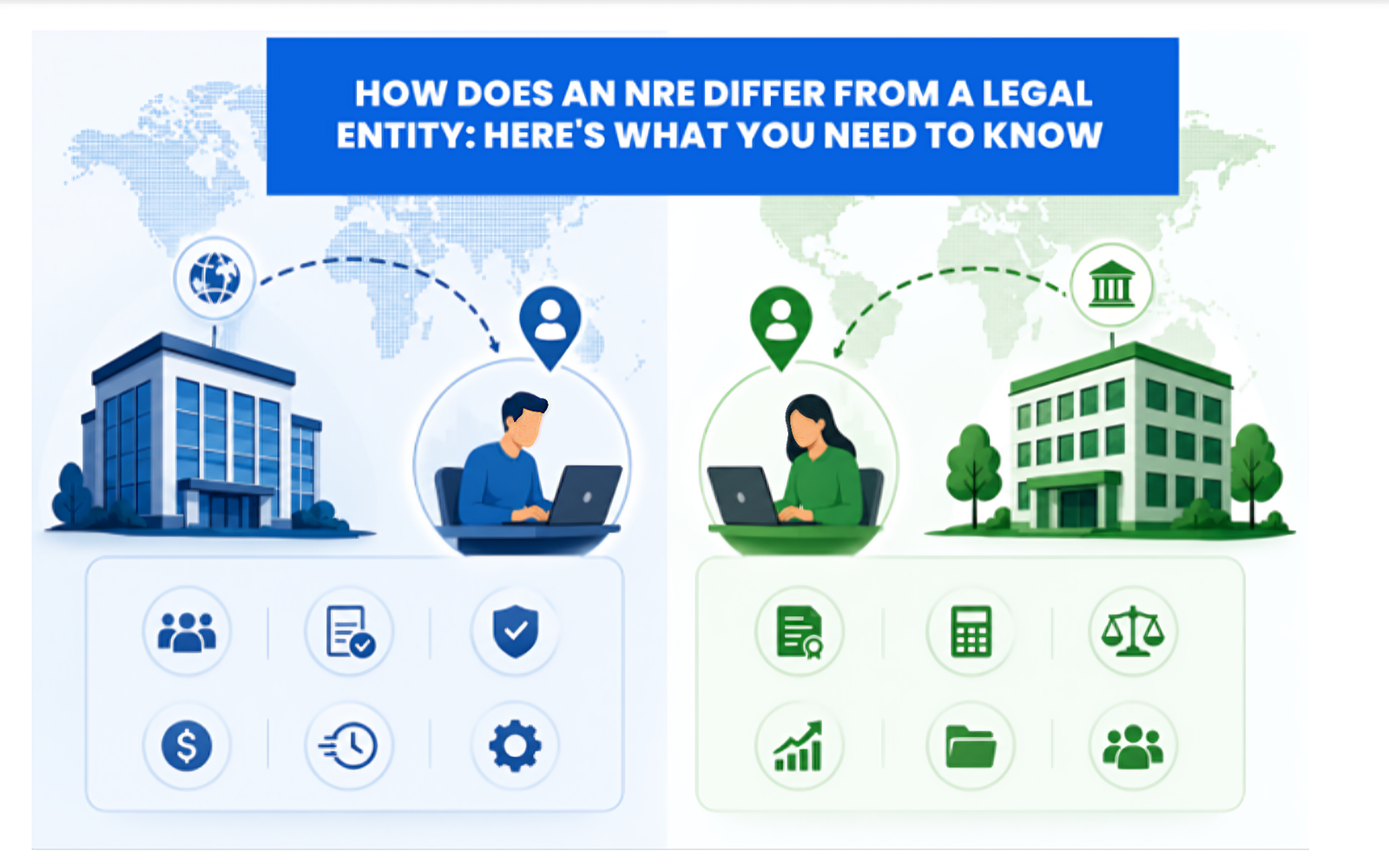
Every company expanding across borders eventually hits the same fork: register as a non-resident employer, or incorporate a legal entity.
Both let you hire compliantly abroad, but the similarity ends there. One gets you a signed contract in weeks; the other hands you full commercial control at the cost of months and fixed overhead. However, picking wrong is expensive either way.
Here's exactly where the two models split, and how to know which one your next market actually calls for.
An NRE and a Legal Entity Solve the Same Problem in Completely Different Ways
A Non-Resident Employer (NRE) lets you employ people in a country without setting up a local company. Registration is administrative, not corporate. You're registered as an employer for payroll and tax purposes, nothing more.
A legal entity means you are the local company: incorporated, capitalized, and on the hook for every statutory obligation that comes with operating a business in that jurisdiction, employment included. Same end goal, legally paying people in another country, but completely different mechanisms to get there. Once that distinction is clear, the practical differences follow logically from it.
Five Places Where the Two Models Genuinely Diverge
Here, below are some places where these two models diverge-
Setup Takes Weeks Under an NRE, Months Under a Legal Entity
NRE registration typically clears in a matter of weeks. Entity incorporation runs longer, often 2 to 6 months, depending on jurisdiction, bank account setup, and local notarization requirements. If your hire date is fixed, this alone can decide the model for you.
The Cost Structure Isn't Just Registration Fees vs. Capital
An NRE carries registration and ongoing payroll administration costs. A legal entity carries incorporation fees, minimum capital requirements in some countries, statutory audits, local directors, registered office costs, and annual filings, whether or not you've hired anyone yet.
Compliance Ownership Shifts From the Structure to Your Company
Under an NRE, payroll, tax withholding, and statutory filings are handled under the employer registration; the compliance burden sits with the administrative structure, not with you, building internal expertise in local labor law. Under a legal entity, your company is the direct party to every filing, audit, and inspection.
Permanent Establishment Risk Is the One That Catches People Out
A legal entity is, by definition, a taxable presence. An NRE is structured specifically to employ compliantly without creating a permanent establishment or triggering local corporate tax exposure, provided the activity stays within employment, not revenue-generating operations.
Control Over HR Policy and Benefits Comes at the Cost of Speed
A legal entity gives you full latitude to design your own benefits stack, internal policies, and termination process (within local law). An NRE follows standardized statutory employment terms with less customization, but zero setup lag.
Taken together, these five differences aren't just technical footnotes; they define what each model can and can't be used for.
What Each Model Rules Out, and What It Opens Up?
An NRE Won't Let You Generate Revenue or Fully Customize Policy
- Generate local revenue or invoice customers directly through that registration
- Build a fully custom benefits or equity structure beyond statutory minimums
- Establish a long-term physical corporate presence (offices, local branding as a subsidiary)
A Legal Entity Unlocks Commercial and Operational Control, an NRE Can't
- Local revenue generation and commercial contracting
- Full control over compensation structure, equity plans, and internal policy
- Long-term brand and operational presence in-market
These trade-offs map directly onto where a company sits in its expansion timeline — which is really the question that decides the model.
"Most companies don't get burned by choosing the wrong model; they get burned by outgrowing the right one and not noticing. It's a pattern global mobility advisors flag repeatedly when reviewing expansion strategies."
The Right Model Depends on Which Growth Stage You're In
Testing a Market Calls for an NRE and Scaling One Calls for an Entity
If you're hiring one or two people to validate a market, test a hire, or open a satellite function, an NRE gets you there without sinking capital into infrastructure you may not need in six months. If you're planning sustained headcount growth, commercial operations, and a permanent footprint, entity setup is the model built for that horizon.
Entity Costs Start Paying Off Past Roughly 10-15 Employees
There's no universal number, but the pattern is consistent: below that range, the fixed costs of an entity rarely pencil out against NRE fees. Past that point, and especially once local revenue generation enters the picture, incorporation usually becomes the more economical and often mandatory path.
Four Mistakes That Cost Companies Time and Money on This Decision
- Incorporating too early - building entity infrastructure before there's enough headcount or revenue commitment to justify the fixed costs.
- Staying on NRE too long - running a commercial or revenue-generating activity through an employer registration, which risks triggering the exact permanent establishment exposure the model is meant to avoid.
- Treating the decision as permanent - the two models aren't mutually exclusive across a company's lifecycle; many companies start on NRE and transition to an entity once scale justifies it.
- Ignoring country-specific rules - some jurisdictions restrict how long an NRE-style arrangement can operate before requiring incorporation. This varies by country and needs a local compliance check, not a blanket assumption.
Avoiding these mistakes comes down to running the decision through a consistent framework rather than defaulting to whichever model you used last time.
A Four-Question Framework to Decide Between Them
- Timeline- Do you need someone employed in under a month?
- Headcount trajectory - Testing with 1-5 hires, or planning 15+? Low headcount favors NRE?
- Commercial activity - Employment only, or local revenue and contracting too?
- Time horizon - Is this market a long-term bet or a near-term test?
If most answers point to speed, lower headcount, and employment-only activity, an NRE is the more efficient path. If they point to scale, control, and commercial operations, entity setup is worth the lead time and cost.
Whichever Model Fits, the Execution Still Has to Be Right
Whichever direction the framework points, the operational lift is the same problem: registration, payroll, tax filings, contracts, and compliance all need to be right from day one.
That's the layer we manage at NRE Solutions: employer registration, monthly payroll and tax compliance, locally compliant contracts, and ongoing statutory obligations, handled end-to-end across 20+ countries, without you needing to stand up internal expertise in each jurisdiction. If a market later justifies incorporation, that transition is a conversation, not a scramble.
For example, a logistics company hires three ops coordinators in Poland to support a new regional route. Headcount stays small, and there's no local invoicing planned for at least a year. An NRE gets them employed in under a month, with none of the incorporation costs a two- or three-person team can't justify yet.
When the Model Is Clear, the Right Partner Makes the Difference
Choosing between an NRE and a legal entity is only half the decision. The other half is executing it correctly.
If an NRE is the right fit, NonResidentEmployer.com manages employer registration, payroll, locally compliant employment contracts, tax filings, and ongoing statutory compliance, helping companies hire internationally without establishing a local legal entity.
If your expansion has reached the point where a legal entity makes more sense, Cerity Global supports the full incorporation process, from company formation and registration to HR, payroll, accounting, tax, and ongoing compliance, giving businesses the foundation they need for long-term international growth.
The right structure gets you into the market. The right partner helps you stay compliant as you grow.
Bottom Line: Match the Model to the Stage, Not the Other Way Around
Neither model is universally "better"; they solve different problems at different stages of expansion.
An NRE gets you employed compliantly, fast, without capital tied up in infrastructure you don't yet need. A legal entity gives you full commercial and operational control, at the cost of time, money, and ongoing statutory overhead.
The right call comes down to your timeline, your headcount trajectory, and whether you're testing a market or building a permanent presence in it.
If speed and lower commitment are what you need right now, an NRE is very likely the faster route to your first compliant hire, and it's exactly what we handle, market by market, so you don't have to figure out the compliance layer alone.
Frequently Asked Questions (FAQ)
Not when the arrangement is structured and used correctly, as it's specifically designed to enable compliant employment without creating a taxable local presence. Risk arises when a commercial or revenue-generating activity is run through the same registration.
Yes, it's a common transition when headcount, revenue plans, or local commercial activity outgrow what an NRE is designed to support.
Yes, though the specific rules, registration process, and permitted duration vary by country. Compliance is jurisdiction-specific and should be confirmed per market before hiring.
In most cases, no, since there's no permanent establishment or local entity created, corporate tax exposure typically doesn't apply. Employment taxes and payroll withholding still do.
In many countries, entity incorporation can be completed within a few weeks, considerably faster than the months typically required.